
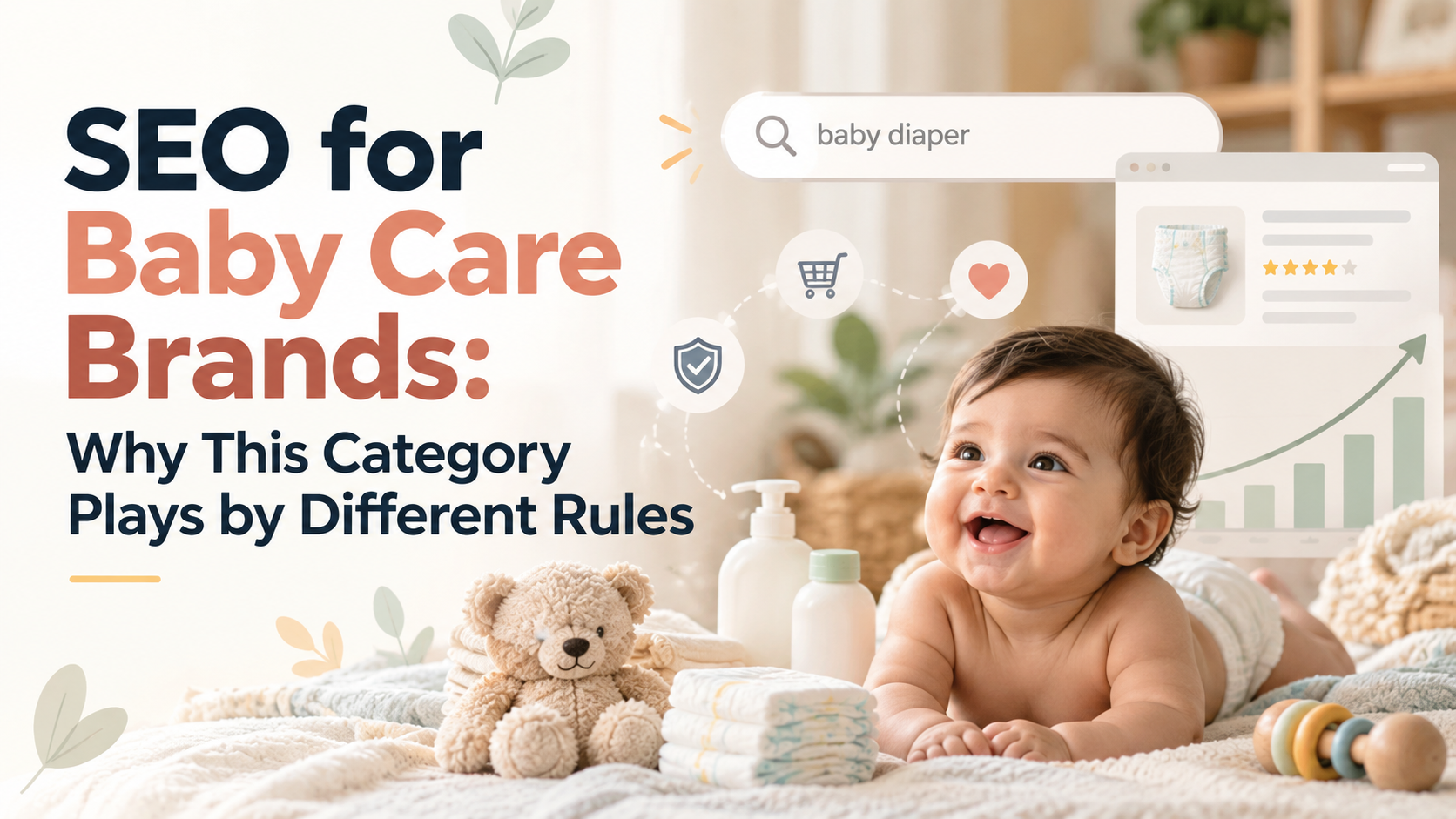
SEO for Baby Care Brands: Why This Category Plays by Different Rules
Most ecommerce SEO advice assumes a fairly rational, low-stakes buyer: someone comparing prices and reading a few reviews before clicking buy. Baby care breaks that assumption completely. Nobody researches a phone charger the way they research a crib mattress.
Why This Category Is Fundamentally Different
The global baby safety products market was valued at $255.83 billion in 2024 and is projected to reach $431.64 billion by 2034 (Precedence Research, via RetailWire) — and the growth is being driven specifically by safety anxiety, not convenience. Recent years have seen viral parenting-group discussions around microplastics-in-bottles lawsuits and federal scrutiny of low-cost marketplaces over product safety, and the U.S. Consumer Product Safety Commission lists roughly 61 recalls in the baby and kids category in a recent count alone (RetailWire). Parents aren’t shopping — they’re vetting. A significant share explicitly look past major retail chains specifically to check smaller or independent brands’ safety credentials before buying (Daily Mom).
This is also, formally, a YMYL category in Google’s own framework — “Your Money or Your Life” content that can affect someone’s health, safety, or major decisions gets held to a materially higher quality bar than ordinary commercial content (Search Engine Land). Baby care sits inside this by default: ingredient safety, feeding guidance, and developmental claims are exactly the content type Google’s Search Quality Raters are trained to scrutinize hardest.
How a New Brand Actually Starts Getting Sales
Everything above is the long game. It’s real, but it’s not what generates revenue in month one — and for a brand new to SEO, that distinction needs to be explicit rather than assumed.
Set the timeline expectation honestly first. New domains, across ecommerce broadly, rarely see SEO-driven revenue in the first three months regardless of execution quality — that period is foundation work (technical setup, product-page optimization, initial content), not ROI. First real sales typically start appearing in months 4-6, with measurable, compounding ROI from month 6 onward (ClickZ; Stryde). This isn’t a baby-care-specific limitation — it’s how new domains behave everywhere, and setting this expectation upfront prevents the common failure mode of abandoning SEO at month three, right before it would have started working.
Within that window, the fast lane is narrow and transactional, not broad and authoritative. A new domain competing head-on for “baby skincare” — broad, competitive, and already owned by hospitals and pediatric associations — will lose that fight for a long time. The advice for new domains generally is the opposite: don’t spend early effort on competitive, high-intent head terms; focus narrowly and grow outward from what you can actually win (Shopify). Long-tail, tightly-scoped product queries compound fastest — often producing first impressions within 2-4 months, since they carry far less competition (SEOJuice). For a baby care brand, that means targeting something like “fragrance-free diaper cream for eczema-prone skin” tied directly to an actual SKU — not “best baby skincare,” which is the institutional-authority battle you’re not ready to fight yet.
Get the product pages themselves right before adding content volume. Whatever early traffic does arrive needs somewhere that actually converts it — clear certifications, structured Product schema (so review stars and availability show directly in search results), and straightforward, complete product information. Content strategy compounds slowly; product-page quality affects the conversion rate of every visitor from day one, including the very first ones.
Run Google Shopping/Merchant Center in parallel, not instead of, organic work. A well-structured product feed gets transactional-intent visibility far faster than organic rankings can, since it doesn’t depend on domain authority in the same way. This isn’t a replacement for the SEO work above — it’s the lever that can produce sales while the 4-6 month organic runway is still building.
Then let the long game — the rest of this piece — become the moat, not the opening move. Once narrow long-tail and product-page SEO are producing a baseline of sales, that’s when investing in the deeper research content, EEAT signals, and institutional-level trust-building described below starts to make sense — it’s what prevents a brand from being stuck permanently fighting only for long-tail scraps, but it’s the second phase, not the first.
The Trap: Traffic That Isn’t Relevant Traffic
Here’s where a lot of baby-brand content strategy goes wrong, and it’s worth naming directly: baby name content generates enormous search volume and is almost entirely irrelevant to a baby-products brand. “Cute baby girl names 2026” gets searched constantly — by people who aren’t shopping for a crib mattress, a stroller, or diaper cream. Publishing this kind of content inflates traffic dashboards without building anything the business actually needs: no purchase intent, no topical relevance to the product catalog, no signal to Google that the site is actually authoritative on baby care rather than baby naming.
This isn’t a hypothetical risk. Google’s Helpful Content system and its broader site-reputation enforcement have specifically targeted the pattern of sites publishing high-volume content that’s topically disconnected from what the site is actually about, purely to capture unrelated search demand (iPullRank). A site that built its traffic on baby names while its actual commercial content stayed thin is exactly the profile these updates are designed to catch — and it’s a pattern that’s played out in the wild, not just in Google’s guidelines. The traffic looks good on a dashboard right up until an update recalibrates around actual topical relevance, and it disappears all at once.
The fix isn’t “never publish adjacent content” — it’s making sure the content you publish is relevant to what a parent is actually researching before buying products like yours: ingredient breakdowns, safety certifications explained, developmental-stage buying guides, “is X material safe” deep dives. That content builds the same topical authority Google and AI systems are actually checking for, while genuinely serving the research-heavy buyer this category is built around.
Competitors Aren’t Just Other Brands
The other mistake is scoping “competitors” too narrowly. A baby care brand’s real competition for search visibility isn’t just other baby care brands — it’s pediatrician association sites, hospital health libraries, government health resources, and long-established parenting media, all of which already carry the institutional trust signals Google rewards in YMYL content. Trying to outrank the AAP or a hospital system on a broad query like “is this safe for newborns” with a commercial brand page is usually a losing fight on authority alone.
The fix: don’t compete on the broad, institutionally-owned queries — compete on the specific, product-adjacent long-tail those sources don’t cover well: ingredient-specific questions tied to your actual formulations, use-case guidance specific to your product category, and comparison content that only makes sense coming from a brand that makes the product. Build genuine E-E-A-T signals to support it — visible medical/expert review where relevant, transparent sourcing, and content that gets revisited and updated rather than published once and left stale, since Google explicitly expects YMYL content to be kept current (Infoserve).
UI/UX Isn’t Separate From SEO Here — It’s Load-Bearing
For a research-anxious buyer, the on-site experience is part of the trust signal, not a separate discipline from SEO. A few things matter disproportionately in this category:
- Certifications and safety information need to be immediately visible, not buried in a spec sheet — a hesitant parent scanning quickly should see safety credentials without hunting for them
- Mobile experience matters more than most categories — a lot of this research happens during feeding sessions or late-night worry-searching, on a phone, one-handed
- Simple, low-friction navigation reduces the chance an already-anxious buyer abandons the decision entirely rather than resolves it
- These aren’t just conversion-rate concerns — dwell time, bounce behavior, and engagement signals feed back into how Google evaluates whether a page actually satisfied the query, so weak UX on trust-critical pages has a real SEO cost, not just a commercial one
The AEO/GEO Argument: Some Content Won’t “Perform” and Should Get Published Anyway
This is the part most SEO advice misses entirely, and it’s specifically relevant to this category right now. A recent academic audit specifically studied Google’s AI Overviews and Featured Snippets for pregnancy and baby care queries, and found this exact content type is already being surfaced through direct-answer AI features at massive scale — AI Overviews reached over 200 countries and 2+ billion monthly users by mid-2025, and the researchers noted that despite YMYL policies demanding extra scrutiny, top-ranked results in this space can still fall short of it (arXiv, 2025).
What that means practically: a well-sourced, clearly-structured page answering “is [ingredient] safe for infants” might get modest direct search traffic — parents increasingly get that answer synthesized inside an AI Overview or a chatbot response without ever clicking through — but it’s exactly the kind of content that gets cited or pulled into those AI-generated answers when it’s genuinely well-sourced and clearly structured. That’s a citation-and-trust play, not a traffic play, and it needs to be budgeted and judged differently. Some pieces in a baby care content plan should be written and green-lit specifically because they’re the right thing for a model to cite when a parent asks the same question directly — not because the keyword’s search volume graph looks good in Search Console.
The Takeaway
Baby care SEO fails when it’s treated like any other ecommerce vertical — chase volume, publish broadly, optimize for clicks. This category rewards the opposite instinct: narrower, more rigorously sourced content, aimed at the specific research questions anxious parents are actually asking, with UX that reinforces trust rather than just streamlining checkout, and a willingness to publish some content for citation and authority rather than for traffic alone.