
SEO for Electric Two-Wheeler Brands: A Different Funnel, Different KPIs
India sold over 1.15 million electric two-wheelers in 2024 alone — a 33% jump from the year before, making India the world’s second-largest electric two-wheeler market by volume (GrowthJockey). It’s also a category where almost none of the standard ecommerce SEO playbook applies cleanly, because almost nobody buys a scooter the way they buy a diaper cream or a phone case.
Why This Isn’t an Ecommerce Funnel
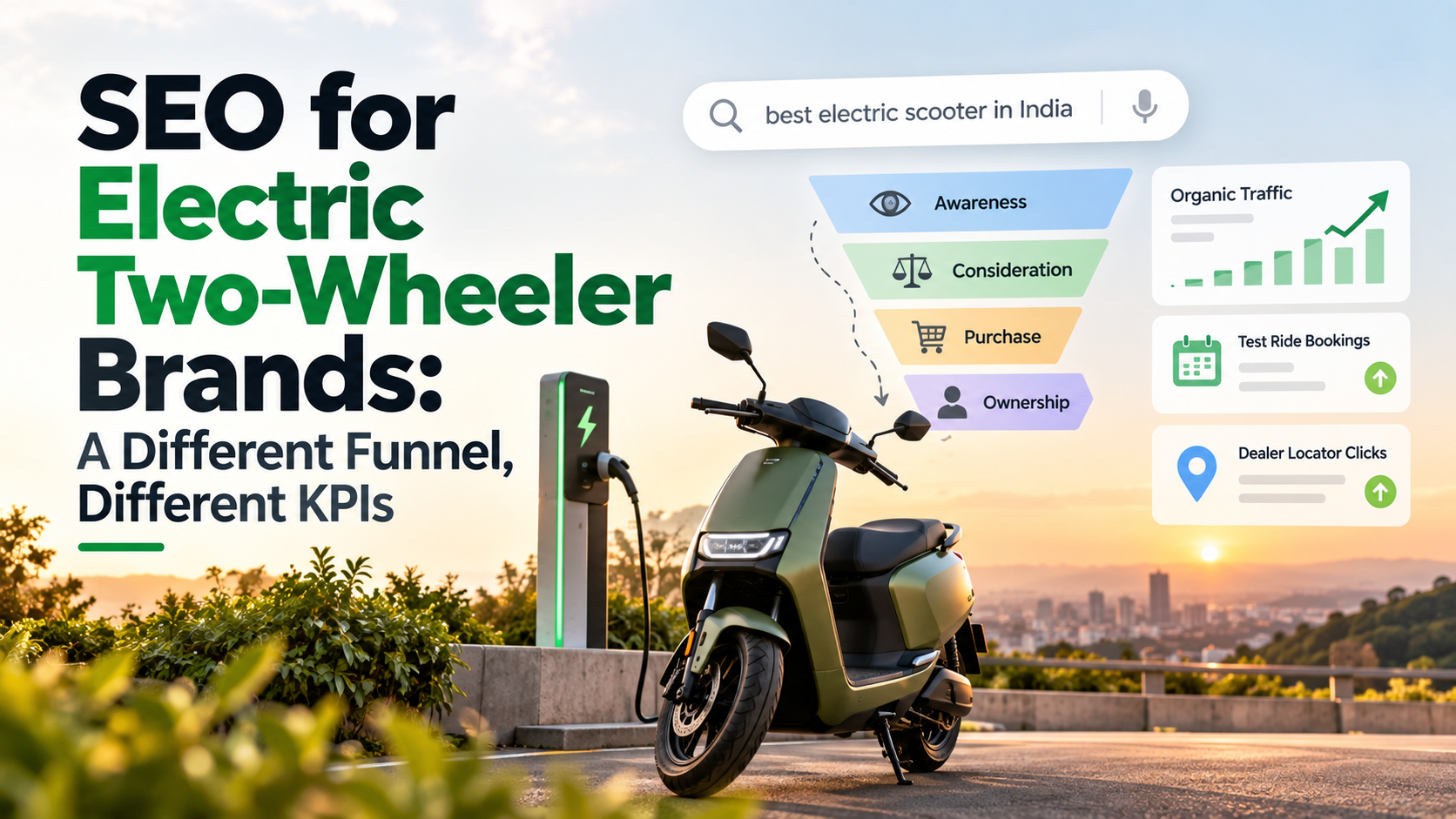
Most buyers research online, then go to a physical dealer for a test ride before committing — a research-to-showroom journey, not a research-to-checkout one. That breaks the standard SEO measurement model immediately: if the actual purchase happens at a dealership, “organic traffic → purchase” as a direct attribution chain simply doesn’t exist for most of this category the way it does for a pure online store.
The Right KPIs for a Research-to-Showroom Funnel
Since the final transaction happens offline, the KPI has to be the best available proxy for “this visitor moved meaningfully toward a purchase decision,” not the purchase itself. In practice, that means tracking:
- Test-ride bookings — the single strongest signal available; it’s a real commitment of time, not a passive click
- Dealer locator interactions — someone checking where to go is functionally further down the funnel than someone reading a spec sheet
- EMI/finance calculator usage — a person modeling monthly payments is seriously evaluating a purchase, not browsing
- Brochure/spec-sheet downloads — a weaker but still real intent signal
- Click-to-call or WhatsApp inquiry clicks — especially relevant in India, where WhatsApp is often the actual first point of human contact with a dealer
Track these as your primary conversion events, the same way an ecommerce site tracks add-to-cart or checkout — because for this category, they’re the closest real equivalent.
The Branded-Traffic Trap, Applied to This Category Specifically
This deserves the same discipline we’ve argued for elsewhere: never assume rising branded search means your SEO/content work caused it. In this category specifically, there are several plausible alternative causes that have nothing to do with organic content:
- A new model launch generating press coverage and word-of-mouth searches
- A TV, OOH, or influencer marketing campaign running in parallel
- A subsidy policy announcement putting the whole category (or a specific brand) into the news
- A competitor’s public stumble — a fire incident, a recall, a bad review going viral — pushing comparison-shopping traffic toward your brand instead
- Festive-season timing — vehicle purchases in India cluster heavily around specific auspicious periods, independent of any marketing activity at all
The actual validation process, adapted from general SEO measurement practice: check whether the branded search rise correlates with a specific dated event (a launch, a subsidy announcement, a competitor incident) before crediting content work. If branded search rose the same week a subsidy scheme was announced nationally, that’s the far more likely cause — and a much harder one to take credit for. Only when branded growth shows no clear external trigger, and correlates instead with your own publishing cadence, does the SEO-attribution hypothesis actually hold up.
City and State-Level Targeting Is a Real Content Opportunity, Not a Thin One
This is the part where this category genuinely differs from most “local SEO” advice — because the variation between cities isn’t cosmetic, it’s substantive. India’s EV two-wheeler subsidies are set at the state level, on top of whatever central scheme is active, and they vary meaningfully: Haryana offers ₹5,000 per kWh capped at ₹30,000 with road tax exemption; Uttar Pradesh offers 15% of ex-factory price capped at ₹5,000 plus a five-year road tax waiver; Delhi adds an additional ₹5,000 per kWh on top of the central scheme (Zelio; Godigit). A page built around “electric scooter subsidy in Uttar Pradesh” and one built around “electric scooter subsidy in Delhi” aren’t the same content with a city name swapped — they describe genuinely different numbers, eligibility rules, and savings. That’s exactly the kind of real, differentiated data per page that avoids the thin-content risk we’ve flagged elsewhere in this glossary and blog — a legitimate case for building out state-specific content deliberately, not a workaround.
Central scheme volatility adds to this: FAME II ended March 31, 2024, replaced temporarily by the Electric Mobility Promotion Scheme, and buyer confusion about which scheme is currently active is well documented — sources explicitly note that “many buyers feel confused” about whether FAME II is still valid and how much subsidy actually applies (Bajaj Finserv). Content that stays current here isn’t just an SEO freshness signal — it directly resolves genuine buyer confusion, which is a real trust and conversion asset on top of any ranking benefit.
Range Anxiety: The Barrier Worth Addressing Head-On, Not Around
Industry voices continue to name range anxiety as a primary reason people hesitate to switch from petrol to electric, even as underlying specs improve (The Secretariat) — this is a psychological barrier as much as a technical one, and content that only recites a spec sheet doesn’t resolve it. What does: real-world range content (city-driving range versus lab-test range), honest charging-time comparisons, and charging-infrastructure context — public charging points in India grew from 451 in 2021 to over 13,000 by 2023 (Godigit), which is a genuinely reassuring, concrete number most range-anxiety content never mentions because it requires going beyond the brand’s own spec sheet.
The Video/YouTube Layer — Don’t Treat This as Text-Only SEO
Two-wheeler research in this category leans heavily on video — comparison reviews, real-world range tests, and unboxing-style first impressions are a primary research format, not a supplement to written content. At least one EV company’s own SEO job listing explicitly pairs “YouTube SEO” with content SEO as one coordinated responsibility rather than two separate functions. Practical implication: video titles, descriptions, and even on-video mentions of city/state-specific terms (subsidy amounts, range figures) should be planned alongside the written content strategy, not bolted on afterward — a comparison article and a comparison video targeting the same query cluster should reinforce each other, not compete for the same keyword independently.
The Takeaway
This category punishes SEO strategies borrowed wholesale from pure ecommerce. The funnel ends offline, so the KPI has to be a genuine intent proxy, not a purchase event. Branded traffic growth needs the same causal skepticism we’ve argued for everywhere else, with this category’s own specific list of confounders. And the content that actually works here treats geography and government policy as substantive variables worth real, differentiated pages — not decoration on a generic template.