
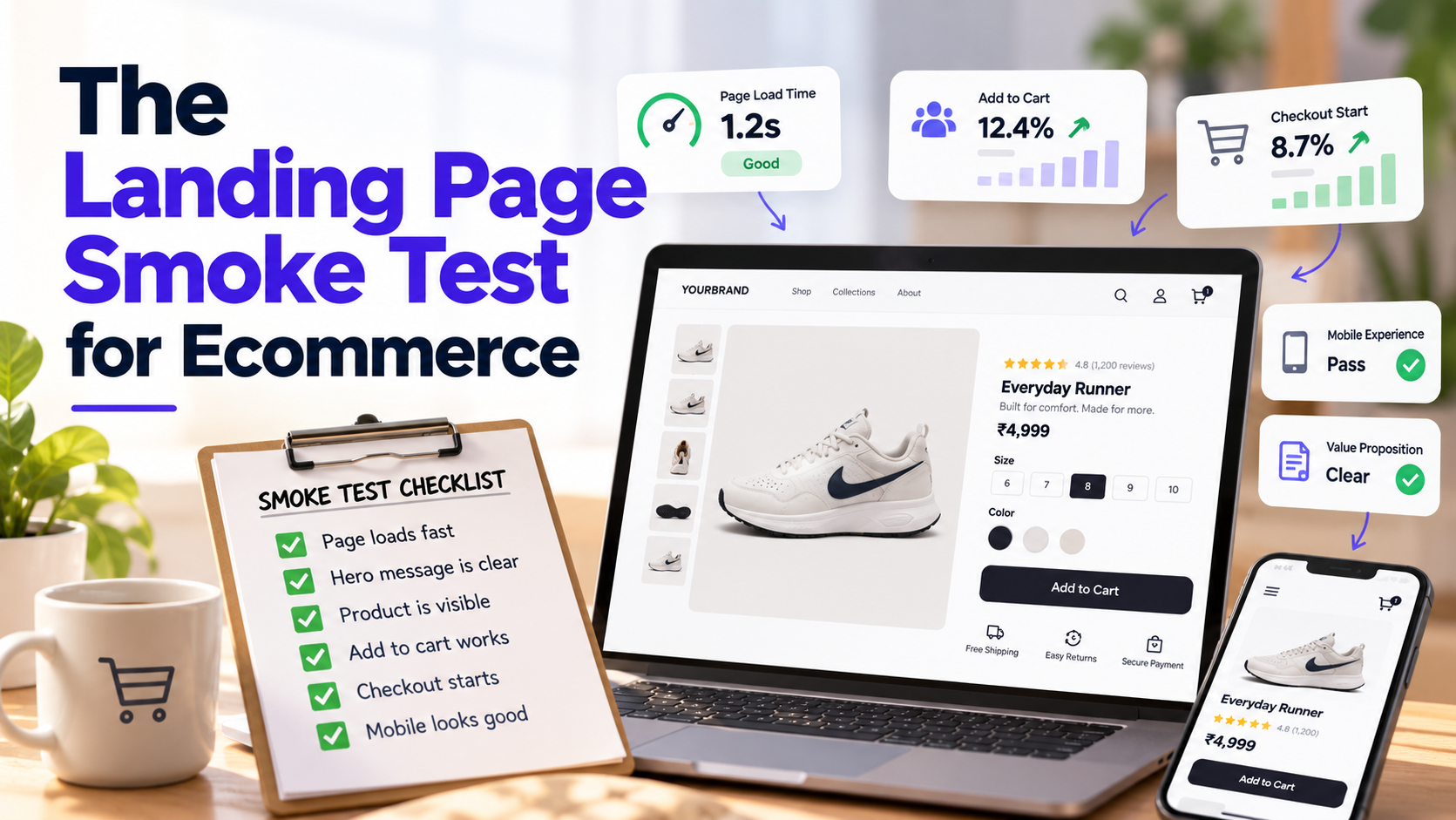
The Landing Page Smoke Test for Ecommerce: Validating Demand Before You Buy Inventory
Most explanations of smoke testing borrow their flagship example from software — Buffer’s famous fake “Plans and Pricing” button, which simply led to an email signup page while the product didn’t exist yet. That’s a fine example for SaaS. It’s also the wrong starting point for ecommerce, because ecommerce has a different, more specific risk: real money and real inventory expectations, not just an email address.
Three Methods That Get Conflated, and Shouldn’t Be
Fake-door test — a non-functional button or menu item added to an existing product, measuring click-through rate on a feature that doesn’t exist yet. This validates one feature for one product, not a whole business.
Smoke test (landing page) — a full page describing a product that doesn’t exist yet, measuring clicks, signups, or pre-orders. This is what most people mean by “smoke test,” and it’s built for validating a whole new product concept before building it.
Concierge / Wizard of Oz test — the product appears fully functional to the customer, but is manually operated behind the scenes rather than actually built. This is the one ecommerce founders underuse, and it’s the one that actually built Zappos.
The Real Zappos Story — and Why the Framing Matters
Nick Swinmurn’s actual approach in 1999 wasn’t a fake “sold out” page. He photographed shoe inventory at local San Francisco stores, posted the photos on a basic website, and when an order came in, he drove to the store, bought the shoes at full price, and shipped them himself (Fortune; Alexander Jarvis). Customers received a real product. The company was essentially breaking even on every order — the test wasn’t about margin, it was about proving the hypothesis.
Swinmurn’s own reasoning for testing in the first place is worth noting: he’d found that footwear was already a $40 billion industry in the US, and roughly 5% of all shoes sold were already being purchased through mail-order catalogs with no fitting room involved — meaning a meaningful slice of buyers were demonstrably comfortable buying shoes sight-unseen already (Fortune). The test wasn’t validating “will anyone buy shoes online” from zero — it was validating a hypothesis already grounded in a real, cited data point. Within the early weeks, orders reached roughly $2,000 a week (O’Reilly / Lean Entrepreneur). Zappos was acquired by Amazon a decade later for roughly $1.2 billion.
Why this distinction matters for ecommerce specifically: a pure fake-door “sold out, notify me” page risks real reputational damage in ecommerce, because the visitor often got close enough to attempt a purchase before hitting the wall — that’s a sharper disappointment than a SaaS user who just wanted early access to a feature. Fake-door testing guides explicitly flag this: customers can feel “scammed” if the test isn’t communicated honestly (GetHorizon). The concierge approach Zappos actually used avoids this entirely — nobody felt deceived, because they got a real pair of shoes.
What the Numbers Actually Mean
Benchmarks vary by source, but a consistent range emerges across multiple independent write-ups:
- Click-through rate: 2-5% from cold traffic is considered a meaningful signal; below 1% typically suggests reconsidering the concept (Personizely)
- Email/signup conversion from cold traffic: 5-10% is solid; above 10% generally indicates genuine interest worth pursuing further (Kromatic; User Intuition)
- Overall conversion banding: 3-5% signals weak interest, 6-10% is promising, 10-20% suggests strong pull — though a high-ticket or niche product can treat even 2% as meaningful if the leads are genuinely qualified (FounderFAQs)
- Minimum sample size: aim for at least 300-500 visitors matching your actual target buyer before drawing any conclusion — smaller samples swing too wildly to trust (CleverX)
The number that matters most, and gets ignored most often: signup-to-actual-purchase conversion typically runs 5-15%, meaning 85-95% of your “positive” smoke-test signal evaporates the moment real money is on the line (User Intuition). A smoke test measures interest, not willingness to pay — treat a strong signup number as “worth testing further with a real price,” not as proof the product will sell.
Use Paid Traffic, Not Organic — This Is Not an SEO Play
A smoke test needs fast, controlled, measurable traffic, and organic search cannot deliver that. Even a well-executed SEO campaign on a new domain typically takes 4-6 months before producing meaningful traffic. A smoke test needs its answer in 1-2 weeks. Paid search and social traffic are explicitly the more reliable choice here specifically because you control volume and timing — you’re not waiting on an algorithm to decide your page deserves visibility (User Intuition). This is one of the few places in ecommerce marketing where paid spend is the right tool even for a bootstrapped operation with no ad budget history — a few hundred dollars of tightly-targeted traffic buys a real demand answer faster than months of organic effort would.
The Takeaway
For ecommerce specifically, the honest version of a smoke test looks more like Zappos than like Buffer: real fulfillment behind a simple front end beats a disappointing “sold out” page, both ethically and as a cleaner data source, since actual purchase behavior is a stronger signal than a click on a fake button. Drive it with paid traffic so the answer comes back in weeks, hold the 300-500 visitor minimum before trusting the number, and treat even a strong signup rate as a hypothesis worth a real price test — not as proof you should order inventory.