

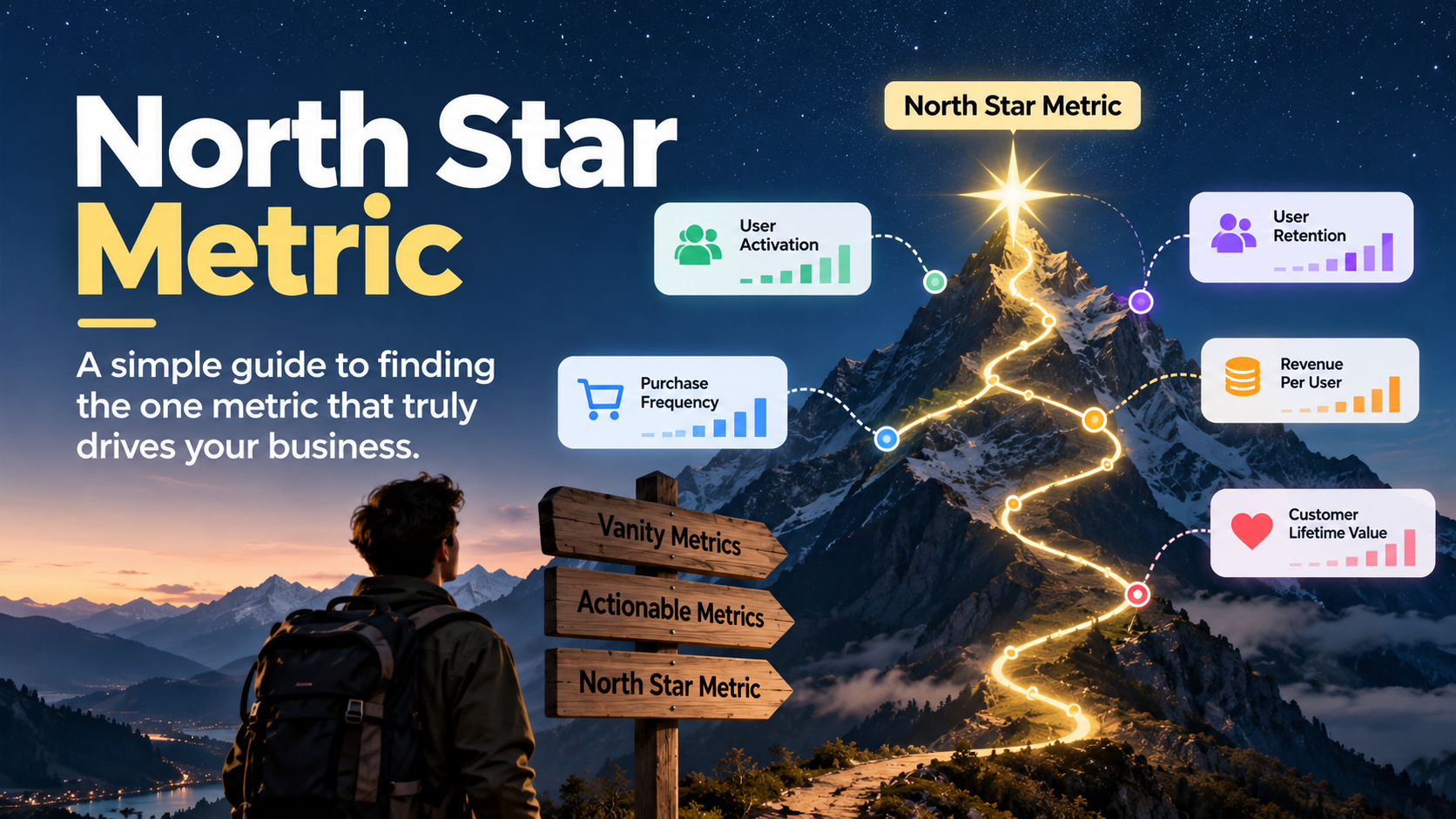
North Star Metric: The One Number That Keeps Your Business Moving in the Right Direction
Every growing business tracks dozens of metrics: revenue, sign-ups, conversion rates, retention, engagement, customer acquisition cost, and more. These numbers are useful, but they can also create confusion.
When every team focuses on a different goal, the organization may become busy without necessarily creating meaningful customer value. This is where the North Star Metric helps. It gives the company one central measure that connects customer value with sustainable business growth.
What Is a North Star Metric?
A North Star Metric is the single metric that best represents the core value a product delivers to its customers.
It answers a fundamental question:
What value do customers consistently receive from our product?
For example:
- A music-streaming service might track hours of music listened.
- A food-delivery platform might measure completed orders.
- A collaboration tool might measure projects completed with multiple contributors.
- A marketplace might track successful transactions.
- An online learning platform might measure lessons completed by active learners.
The specific metric differs from business to business. The principle remains the same: the metric should reflect a meaningful customer outcome, not merely internal activity.
A strong North Star Metric also tends to be a leading indicator of future revenue. In other words, when customers receive more value, they are more likely to stay, upgrade, purchase again, or recommend the product.
Why Does It Matter?
A North Star Metric helps an organization separate important signals from distracting numbers.
1. It aligns teams
Product, marketing, sales, customer success, and engineering can work toward a shared outcome instead of optimizing disconnected goals.
For example, marketing may focus on attracting users, product may focus on activation, and customer success may focus on retention. These activities can all support one common metric: the number of customers who achieve the product’s core value each month.
2. It encourages customer-focused decisions
Revenue is essential, but revenue alone does not always explain whether customers are receiving value. A company can temporarily increase revenue through aggressive pricing, promotions, or one-time sales without improving the product experience.
A customer-value metric provides a healthier perspective. It asks whether users are actually benefiting from the product.
3. It improves prioritization
Teams constantly face competing ideas and requests. A North Star Metric offers a practical filter:
Will this initiative help more customers experience meaningful value?
If the answer is no, the initiative may not deserve immediate priority.
4. It supports long-term growth
A useful North Star Metric connects customer behavior with business performance. When customers repeatedly achieve value, important business outcomes—such as retention and revenue—often improve as a consequence.
This makes the metric more useful than a short-term vanity measure such as total downloads or website visits.
North Star Metric vs. KPI
A North Star Metric is not a replacement for every other metric in the business. It sits at the top of a measurement system.
| Metric type | Purpose | Example |
|---|---|---|
| North Star Metric | Measures the core value delivered to customers | Monthly successful projects completed |
| KPI | Tracks a specific business or team performance area | Conversion rate |
| Input metric | Measures an activity that influences the main metric | Number of activated users |
| Lagging metric | Shows an outcome after it happens | Quarterly revenue |
| Diagnostic metric | Helps explain why performance changed | Feature adoption rate |
A company may have many KPIs, but it generally benefits from having one company-level North Star Metric. Supporting metrics explain how teams can influence it.
For example, if the North Star Metric is “weekly active customers completing a task,” supporting metrics might include:
- New-user activation.
- Weekly retention.
- Task completion rate.
- Time to first value.
- Support resolution time.
- Repeat usage.
This structure is often called a metric tree: supporting inputs feed into the North Star Metric, which should ultimately connect to revenue and sustainable growth.
What Makes a Good North Star Metric?
A strong North Star Metric usually has five characteristics.
It reflects customer value
The metric should represent something customers genuinely want to achieve.
“Number of emails sent” may be a weak metric for an email platform if customers care more about qualified replies or completed sales conversations.
It is measurable
The metric should be defined clearly enough that different teams calculate it in the same way.
A vague goal such as “improve customer happiness” is valuable as a vision, but it is difficult to use as a precise operating metric. A measurable alternative might be “the percentage of customers who successfully complete their first project within seven days.”
It is actionable
Teams must be able to influence the metric through product improvements, marketing programs, customer education, or operational changes.
A metric that changes but cannot be influenced is not a useful management tool.
It supports long-term growth
The North Star Metric should have a strong relationship with retention, expansion, or revenue. It should not reward behavior that creates short-term activity but harms the customer experience.
It is a leading indicator
Revenue is usually a lagging indicator: it tells you what has already happened. A North Star Metric should help predict future business performance.
For a subscription product, “customers who use the product successfully every week” may be more useful for product decisions than monthly recurring revenue alone.
How to Find Your North Star Metric
Finding the right metric requires more than choosing the number that appears most often in an executive dashboard.
Step 1: Define the customer’s value moment
Identify the moment when customers receive the central benefit of your product.
Ask:
- What problem are customers hiring us to solve?
- What does success look like from their perspective?
- What action shows that they have received value?
- What behavior is associated with continued usage?
For a project-management tool, the value moment might be a team completing work together—not simply creating an account.
Step 2: Convert the value moment into a behavior
Turn the abstract value into something observable.
Instead of “customers become more productive,” consider:
“Teams complete and share work using the platform each week.”
This can then become a measurable metric such as:
“Weekly active teams completing at least one shared project.”
Step 3: Add a meaningful time period
Frequency matters. A metric should specify whether it is measured daily, weekly, monthly, or over another period.
“Active users” is incomplete. “Weekly active users who complete the core action” is more precise.
The correct time period depends on the product’s natural usage cycle. A daily habit product may use daily activity, while an enterprise platform may need a weekly or monthly measure.
Step 4: Check the relationship with retention and revenue
A candidate metric should be tested against historical customer behavior.
For example, compare customers who achieve the proposed value moment with customers who do not. If customers who complete the action are more likely to retain or expand, the metric may be a strong candidate.
This validation is important because a metric can sound customer-focused without actually predicting business success.
Step 5: Build supporting metrics
Once the North Star Metric is selected, identify the inputs that influence it.
A simple metric tree might look like this:
- North Star Metric: Monthly customers reaching a successful outcome.
- Input 1: New users completing onboarding.
- Input 2: Users reaching the first value moment.
- Input 3: Weekly repeat usage.
- Input 4: Customers receiving support before becoming inactive.
This gives each team a practical way to contribute.
Examples Across Industries
| Business | Possible North Star Metric | Customer value represented |
|---|---|---|
| Online learning | Lessons completed by active learners | Progress toward learning goals |
| Food delivery | Completed orders delivered successfully | Convenient access to meals |
| Collaboration software | Teams completing shared work | Productive collaboration |
| E-commerce marketplace | Successful buyer-seller transactions | Customers finding and purchasing useful products |
| Fitness application | Weekly workouts completed | Progress toward fitness goals |
| Streaming platform | Hours of content meaningfully watched | Entertainment value |
| Banking application | Successful financial actions completed | Customers managing money effectively |
These examples are starting points, not universal answers. The right metric depends on the company’s business model, customer journey, and definition of value.
Common Mistakes to Avoid
Choosing revenue as the only metric
Revenue is important, but it does not always show whether customers are receiving value. A North Star Metric should generally explain the customer behavior that leads to revenue, rather than simply restating revenue itself.
Using vanity metrics
Downloads, page views, registered accounts, and social-media impressions can look impressive but may not indicate meaningful product usage.
A metric is valuable only if it connects to customer outcomes and business health.
Picking a metric because it is easy to measure
The easiest metric to collect is not necessarily the most useful one. Avoid selecting a metric simply because it already exists in a dashboard.
Optimizing for volume without quality
More activity is not always better. For instance, increasing the number of support tickets or messages sent may indicate frustration rather than value.
Add quality conditions where necessary. “Messages sent” may be weaker than “messages receiving a useful response.”
Treating the metric as permanent
A company’s product, customers, and strategy evolve. The North Star Metric may need to change when the business enters a new stage or launches a substantially different product.
The metric should provide direction, not become a rigid rule that prevents adaptation.
A Practical Template
You can define your North Star Metric using this format:
Our North Star Metric is [specific customer behavior] per [time period], because it represents [customer value] and is expected to drive [business outcome].
For example:
Our North Star Metric is the number of small businesses that send three or more successful invoices each month, because it represents consistent use of our billing solution and is expected to improve retention and subscription growth.
This definition is specific, measurable, and connected to both customer value and business performance.
Final Thoughts
A North Star Metric is more than a number on a dashboard. It is a shared definition of progress.
The best North Star Metrics connect three things:
- The value customers receive.
- The actions teams can influence.
- The business outcomes the company needs to achieve.
When chosen carefully, the metric helps teams prioritize better, communicate more clearly, and focus on sustainable growth. The goal is not to ignore every other metric. It is to understand how those metrics work together to create meaningful customer value.