
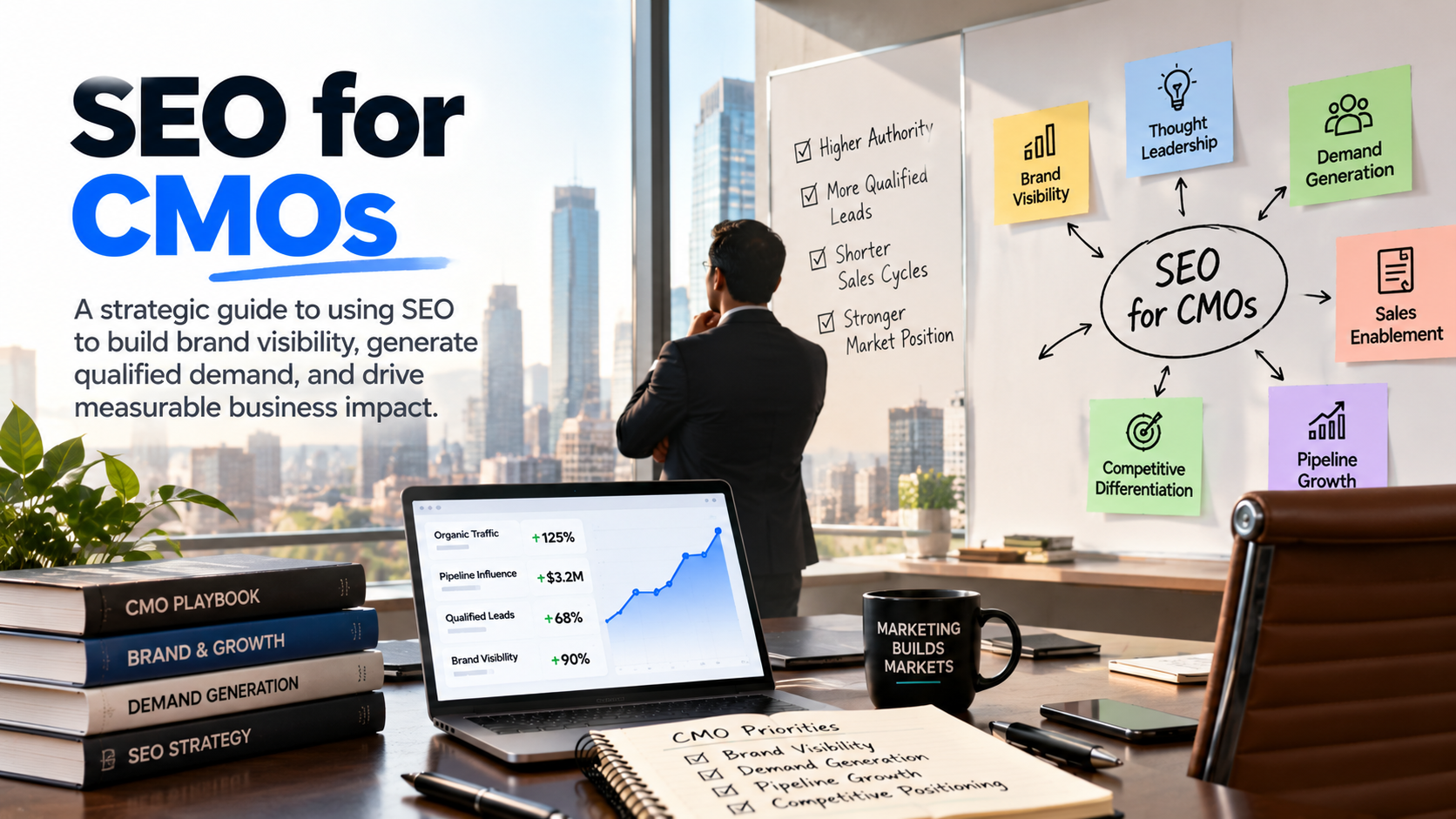
SEO for CMOs: How to Measure It, Avoid Being Fooled, and Prove Long-Term ROI
For a CMO, SEO should not be treated as a technical channel managed in isolation. It is a compounding demand-creation system that influences how buyers discover, evaluate, trust, and choose your brand.
The problem is that SEO is often reported with metrics that look impressive but say little about business impact: rankings, impressions, traffic, backlinks, and blog output. Those metrics can help diagnose performance, but they are not the reason a board or CFO should fund SEO.
A CMO needs a simpler question:
Is organic search creating qualified demand, pipeline, and revenue more efficiently than the alternatives?
This guide gives you a practical framework for measuring SEO as a CMO, spotting misleading reporting, and calculating SEO ROI over the long term.
Why SEO Deserves CMO Attention
SEO is different from most paid channels because its value compounds. A well-positioned page, strong brand entity, useful comparison asset, or authoritative resource can continue attracting qualified demand long after the initial investment.
That does not mean SEO is free or fast. It requires content, technical infrastructure, digital PR, conversion experience, sales alignment, and consistent investment. But when it works, SEO can reduce dependence on paid acquisition and improve the economics of demand generation.
For a CMO, SEO should answer four strategic questions:
- Are buyers discovering us for the topics that matter?
- Are we visible when buyers compare vendors?
- Are we creating qualified pipeline, not just traffic?
- Is organic acquisition becoming more efficient over time?
Modern SEO measurement increasingly extends beyond Google rankings to AI-powered discovery, where buyers may encounter brands through AI answers, citations, and research summaries. Pipeline, closed-won opportunities, and revenue still determine whether that visibility creates business value.
How CMOs Should Measure SEO
Do not start with a list of SEO metrics. Start with the business outcome you want SEO to influence.
For most B2B organizations, the primary SEO metric should be one of these:
- Organic-sourced qualified pipeline value
- Organic-sourced sales-qualified opportunities
- Closed-won revenue influenced by organic search
- Qualified demo requests or trial starts from non-brand search
For e-commerce or transactional businesses, the primary metric may simply be organic revenue.
Use a Three-Layer Measurement Model
A CMO-friendly SEO dashboard should separate leading indicators, conversion indicators, and business outcomes.
| Layer | Purpose | Metrics |
|---|---|---|
| Leading indicators | Are we becoming more discoverable? | Non-brand impressions, keyword-cluster visibility, AI citation share, branded search lift |
| Conversion indicators | Is visibility becoming demand? | Qualified conversions, demo requests, trial starts, MQLs, SQLs |
| Business outcomes | Is demand becoming revenue? | Pipeline value, closed-won revenue, ARR, CAC, CAC payback, LTV:CAC |
This structure prevents the common mistake of reporting activity as if it were impact.
1. Track Non-Brand Organic Demand
Brand traffic is important, but it is often driven by paid campaigns, PR, events, outbound sales, word of mouth, or existing customers. It does not always prove that SEO is creating new demand.
Track:
- Non-brand organic sessions.
- Non-brand organic conversions.
- Non-brand impressions and clicks.
- Visibility for category, solution, comparison, and alternative keywords.
- Branded versus non-branded traffic mix.
A useful CMO-level metric is:
If most organic traffic is branded, SEO may be capturing existing demand rather than creating it. That can still be valuable, but it should be measured differently.
2. Measure Visibility by Buyer Journey Stage
Ranking for one keyword is not a strategy. Measure visibility across the stages of the buying journey.
| Buyer stage | Search intent | Example queries | What to measure |
|---|---|---|---|
| Problem awareness | Buyers identify a challenge | “how to reduce customer churn” | Impressions, engagement, email capture |
| Solution research | Buyers explore categories | “customer success software” | Non-brand clicks, product-page sessions |
| Vendor evaluation | Buyers compare options | “best customer success platforms” | Comparison-page traffic, demo requests |
| Decision support | Buyers validate a choice | “[competitor] alternatives,” “pricing” | Conversion rate, pipeline creation |
| Brand validation | Buyers research you directly | “your brand reviews” | Branded search, review visibility, conversion |
This approach shows whether SEO is supporting the full buying journey—not merely attracting top-of-funnel readers.
3. Measure Traffic Quality, Not Just Traffic Volume
A CMO should ask: Are the right companies finding us?
Useful quality metrics include:
- Organic sessions from ideal customer profile accounts.
- Organic sessions by industry, company size, geography, and persona.
- Engagement on pricing, product, case-study, and comparison pages.
- Repeat visits from the same account.
- Organic traffic that reaches a sales-qualified page.
For B2B, a visitor who reads a case study, returns to a comparison page, and then views pricing is more commercially meaningful than a visitor who reads one blog article and leaves.
4. Measure Conversion Quality
Do not treat every conversion as equal. A template download is not the same as a demo request. A newsletter signup is not the same as a sales-qualified opportunity.
Track conversion events by value:
| Conversion event | Typical value | CMO treatment |
|---|---|---|
| Demo request | High | Primary conversion metric |
| Trial signup | High for PLG | Track activation, not just signup |
| Consultation booking | High | Primary conversion metric for services |
| Pricing-page conversion | High | Strong buying-intent signal |
| Gated asset download | Medium | Useful only if it produces qualified follow-up |
| Newsletter signup | Low to medium | Nurture metric, not a revenue proxy |
The key is to connect each conversion to a defined next step in the revenue process.
5. Connect SEO to Pipeline and Revenue
This is the most important shift for a CMO.
Instead of reporting:
“We generated 500 organic leads.”
Report:
“Organic search generated 42 SQLs, influenced $820,000 in pipeline, and contributed $240,000 in closed-won ARR.”
Track:
- Organic MQLs.
- Organic SQLs.
- Sales-accepted opportunities.
- Organic-sourced pipeline value.
- Organic-influenced pipeline value.
- Closed-won revenue.
- New ARR or MRR.
- Organic win rate.
- Average deal size from organic.
Use both sourced and influenced attribution:
- SEO-sourced pipeline: Organic search was the first meaningful touchpoint.
- SEO-influenced pipeline: Organic search appeared somewhere in the buyer journey before the opportunity was created.
B2B buyers rarely convert after one search. They may discover your brand through educational content, return through branded search, compare vendors, download a resource, and only then speak with sales. Last-click attribution often understates SEO’s role in that journey.
6. Measure AI Search Visibility
Buyers increasingly use AI-powered search and assistants during research. A CMO should know whether the brand appears when buyers ask commercially relevant questions.
Track:
- Brand mentions in AI-generated answers.
- Brand citations for category and comparison prompts.
- Share of model versus competitors.
- Accuracy of brand descriptions.
- Presence in “best of,” “alternatives,” and “vs.” responses.
- Referral traffic from AI platforms, where measurable.
A practical AI visibility scorecard might track prompts such as:
| Prompt type | Example | What to measure |
|---|---|---|
| Category | “Best B2B SEO agencies” | Brand mention and citation |
| Comparison | “Growth Dispatch vs. other SEO agencies” | Brand accuracy and positioning |
| Problem-solving | “How to measure SEO ROI” | Citation and thought-leadership presence |
| Buying decision | “How to choose an SEO agency” | Shortlist inclusion |
The goal is not to chase every AI mention. It is to be accurately represented for prompts that influence buying decisions. AI visibility, referral traffic, downstream demand, and revenue should be measured as connected layers rather than isolated metrics.
How Not to Get Fooled by SEO Reporting
SEO is unusually vulnerable to vanity reporting. A CMO should be able to look at a dashboard and ask sharper questions than “Did traffic go up?”
1. Do Not Accept Total Traffic as Success
Total organic traffic can rise while pipeline falls.
This happens when a site attracts:
- Low-intent informational visitors.
- Audiences outside the ideal customer profile.
- Traffic from broad topics unrelated to the product.
- Visitors who consume content but never encounter a commercial path.
Ask:
“How much of this traffic came from non-brand search, reached commercial pages, and converted into qualified demand?”
Raw clicks can include low-intent visitors who never become buyers. A better measure is productive pipeline traffic: visitors who enter through search and take a meaningful commercial action.
2. Do Not Confuse Rankings With Revenue
A page-one ranking is useful only if it reaches buyers with commercial intent.
Ask:
- Which keyword cluster produced the ranking?
- Does that cluster map to a product or service we sell?
- Did the ranking produce qualified traffic?
- Did it create conversions or opportunities?
- Is the ranking stable across locations, devices, and query variations?
A single keyword position can be misleading because search results vary by user, location, personalization, and AI-generated results. Share of visibility across a commercial topic cluster is usually more informative than one keyword position.
3. Do Not Let Backlinks Become the Goal
Backlinks can support authority, but they are not a business outcome.
Beware reports that emphasize:
- Number of links acquired.
- Domain rating improvements.
- Total referring domains.
- Link velocity.
Ask instead:
- Did the links come from relevant, credible publications?
- Did they support pages that target commercial topics?
- Did they improve visibility for buyer-relevant queries?
- Did they contribute to branded search, referral traffic, or pipeline?
A link-building report without a visibility, traffic, or demand outcome is incomplete.
4. Do Not Reward Content Volume
Publishing 40 articles per month is not a strategy. Publishing the right 40 assets over a year may be.
Ask:
- Which content assets generated qualified conversions?
- Which pages influenced opportunities?
- Which pages are decaying and need refreshing?
- Which topics support sales conversations?
- Which pages rank for comparison or decision-stage queries?
Content should be judged by its contribution to demand and revenue—not by publishing cadence alone.
5. Do Not Trust Last-Click Attribution Alone
Last-click attribution can make SEO look weak because buyers often discover a brand through organic search and convert later through direct traffic, branded search, email, or paid retargeting.
Use multiple views:
| Attribution method | What it shows | Limitation |
|---|---|---|
| First-touch | Which channel created initial discovery | Ignores later nurturing |
| Last-touch | Which channel captured the conversion | Often undervalues SEO |
| Multi-touch | How channels work together | Requires clean tracking |
| Account-based | How target accounts engage before opportunities | More complex for enterprise sales |
| Self-reported attribution | How buyers say they found you | Can be biased or incomplete |
No attribution model is perfect. The CMO’s job is to ensure the reporting model is transparent, consistent, and aligned with how buyers actually purchase.
6. Do Not Confuse Correlation With Causation
Branded search may rise after a PR campaign, paid campaign, sales outreach, product launch, or market event—not because of SEO.
Before crediting SEO with a result, check:
- Was there a major campaign during the period?
- Did sales activity increase?
- Did pricing, packaging, or positioning change?
- Did a competitor exit or lose visibility?
- Did seasonal demand change?
- Did AI platforms begin citing the brand?
A credible SEO report explains what changed, why it changed, and what evidence supports the conclusion.
How to Measure SEO ROI Long Term
SEO ROI should not be judged on a 30-day dashboard. It is a compounding investment, and its business impact often becomes clearer over six, twelve, and twenty-four months.
A directional review may begin around six months, while a twelve-month rolling window provides a more credible view of commercial impact.
The Basic ROI Formula
The simple formula is:
For example, if SEO generated $600,000 in closed-won revenue over 12 months and cost $200,000:
That means every dollar invested returned three dollars in revenue.
But this formula is only useful if “revenue from SEO” is defined carefully.
Define Total SEO Cost Honestly
Include all meaningful costs:
- Internal SEO, content, and web-team salaries.
- Agency or consultant fees.
- SEO tools and analytics platforms.
- Content production and design.
- Digital PR and link acquisition.
- Technical development work.
- Conversion-rate optimization.
- AI search monitoring and reporting tools.
Do not calculate ROI using only agency fees. That makes SEO look artificially profitable.
Use Revenue, Not Just Leads
Leads are an intermediate outcome. Revenue is the business outcome.
For a B2B company, calculate:
For subscription businesses, use ARR or MRR where appropriate:
Also track customer lifetime value from organic cohorts. SEO may acquire customers with different retention, expansion, and deal-size characteristics than paid channels.
Measure ROI in Stages
Because SEO matures over time, measure it in stages rather than expecting immediate payback.
| Time frame | What to evaluate | Primary metrics |
|---|---|---|
| Months 0–3 | Foundation and early signals | Technical health, indexing, content coverage, initial visibility |
| Months 3–6 | Directional performance | Non-brand traffic, conversion rate, early MQLs |
| Months 6–12 | Commercial proof | SQLs, pipeline, CAC, early revenue |
| Months 12–24 | Compounding impact | Closed-won revenue, ARR, LTV:CAC, channel efficiency |
| Beyond 24 months | Strategic value | Market share, branded search lift, reduced paid dependency, durable category authority |
This timeline prevents premature judgments. A program may look weak at month three but become highly efficient by month twelve as content ranks, authority builds, and conversion paths mature.
Compare SEO With Paid Acquisition
One of the strongest ways to prove SEO’s value is to compare it with paid channels.
Track:
- CAC by channel.
- CAC payback period.
- Conversion rate by channel.
- Average deal size by channel.
- Win rate by channel.
- LTV:CAC by channel.
- Revenue per dollar spent.
For example:
| Channel | Spend | New customers | CAC | Closed revenue | 12-month ROI |
|---|---|---|---|---|---|
| Paid search | $500,000 | 100 | $5,000 | $900,000 | 80% |
| Organic search | $250,000 | 80 | $3,125 | $720,000 | 188% |
| Paid social | $300,000 | 40 | $7,500 | $520,000 | 73% |
In this example, SEO produced fewer customers than paid search but at a lower CAC and higher ROI. That is the kind of comparison a CFO understands.
Measure the Compounding Effect
SEO’s long-term value comes from assets that continue to perform.
Track:
- Revenue from pages published more than 12 months ago.
- Revenue from refreshed content.
- Organic revenue growth year over year.
- Percentage of revenue from pages created before the current period.
- Cost per organic session over time.
- Cost per organic conversion over time.
A mature SEO program should show improving efficiency: the same or lower investment should produce greater visibility, conversion, and revenue over time.
Long-term SEO ROI is often best evaluated by comparing cumulative revenue over a 12- to 24-month period against the total cost of producing and maintaining the assets that generated it.[clickrank]
A CMO-Ready SEO Dashboard
Keep the executive dashboard focused. A CMO does not need 50 metrics; they need a clear view of performance, efficiency, and risk.
Monthly CMO dashboard
- Non-brand organic sessions.
- Commercial-page organic sessions.
- Qualified conversions.
- Organic MQLs and SQLs.
- Organic-sourced and influenced pipeline value.
- Closed-won revenue or ARR.
- CAC from organic.
- AI visibility for priority buying prompts.
Quarterly board-ready report
Add:
- Year-over-year organic revenue growth.
- SEO ROI.
- CAC payback period.
- LTV:CAC for organic cohorts.
- Channel comparison: SEO versus paid search, paid social, events, outbound, and partners.
- Branded search lift.
- AI citation share for commercial topics.
- Market-share movement in priority keyword clusters.
- Risks: algorithm changes, content decay, technical debt, competitor movement.
Questions Every CMO Should Ask
Use these questions in your next SEO review:
- What percentage of organic traffic is non-brand?
- Which keyword clusters are tied to revenue, not just traffic?
- Which pages generated qualified conversions last quarter?
- How many organic leads became SQLs?
- What is the pipeline value from organic-sourced and influenced deals?
- What is organic CAC compared with paid channels?
- What is the CAC payback period for organic-acquired customers?
- How much closed-won revenue came from organic over the last 12 months?
- Which content assets are compounding, and which are decaying?
- Are we visible and accurately represented in AI-generated answers for commercial queries?
- What would happen to pipeline if we stopped investing in SEO for six months?
That final question is especially powerful. Unlike paid media, SEO does not usually disappear the moment spending stops—but its growth curve slows, competitors gain ground, and content decays without maintenance.
The CMO’s Bottom Line
A successful SEO program should not be judged by how much traffic it creates. It should be judged by whether it builds a durable, efficient demand engine.
The CMO’s measurement system should connect:
Visibility → qualified traffic → conversion → pipeline → revenue → efficient long-term growth
Rankings, impressions, backlinks, and traffic are useful signals. But they are not the destination.
If SEO is working, you should see more non-brand discovery, stronger presence in comparison and AI-driven research, better-quality traffic, more qualified pipeline, lower acquisition costs over time, and revenue that compounds beyond the period in which the investment was made.